


 English - EN
  繁體 - ZH-TW
  简体 - ZH-CN
  Español - ES
  日本語 - JA
  العربية - AR
  Русский - RU
  Français - FR
Two Months to PPWR: What a 50-Year Extrusion Maker Is Actually Worried About
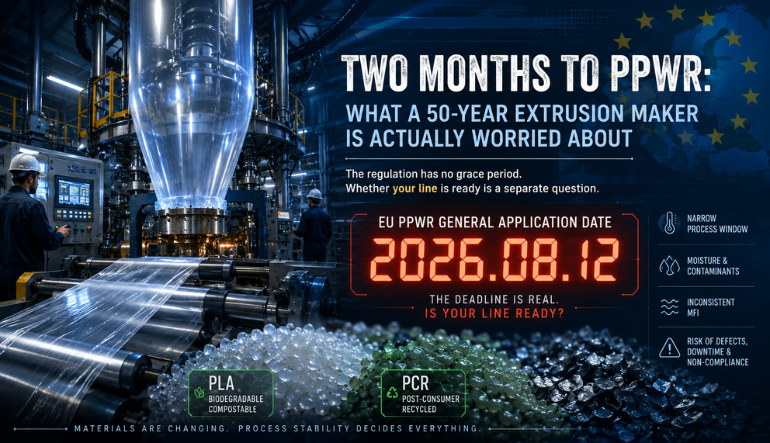
In under two months, the EU's Packaging and Packaging Waste Regulation (PPWR, 2025/40) reaches its General Application Date on August 12, 2026. The date has circulated in plastics-packaging circles for nearly two years, but with only two months remaining, the level of tension across the industry is markedly different from the earlier, more relaxed "there's still time" phase.
Unlike the directive it replaces, which was in force for almost three decades, this is a higher-order instrument: a regulation. It does not wait for member states to transpose it into national law; it applies directly across the entire EU. Just as importantly, it includes no transitional grace period. After August 12, any packaging entering the EU market — whether made in Germany, Poland, or Taiwan — must comply or be withdrawn from sale, with penalties attached. For export-driven manufacturers, this is not simply a "European market matter." It bears directly on a far more immediate concern: whether a given shipment will clear the port at all.
Yet what truly weighs on the extrusion floor is rarely the regulatory text itself — read it once and it is clear enough. The genuine difficulty lies in the very concrete question the regulation forces: once the material changes, can the existing line still extrude it?
The named packaging types — the difficulty is the material, not the rule
Among PPWR's first wave of mandates, several packaging categories are named directly for a move to compostable materials: tea bags, coffee pods, stickers applied directly onto fresh produce, and very lightweight carrier bags. What they share is that they are small, thin, and difficult to recycle, which is why the regulation steers them toward PLA, PBAT, and similar biodegradable resins suited to industrial composting.
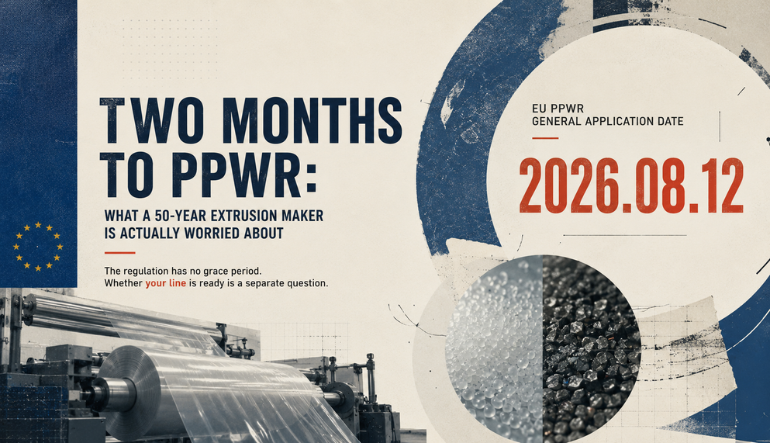
For a brand owner, this sounds like a change of material code and an adjusted procurement spec. For the production floor, it means replacing a material whose characteristics have been understood thoroughly over many years with one of an entirely different nature.
PLA is not PE. The statement seems self-evident, yet it captures the very difference that anyone who has actually attempted the switch feels most acutely. PLA is sensitive to both heat and shear, with a processing window so narrow that drifting roughly ±5°C begins to cause problems: too cool, and the result is melt fracture, surface gelling, and flow lines; too hot, or with too long a residence time in the barrel, and the polymer chains undergo thermal degradation — leaving the product either brittle and short of toughness, or stripped of the very industrial-compostability it was meant to provide. In other words, even with the correct material code, if the machine's process cannot keep pace, the output remains non-compliant and unsellable.
PCR (post-consumer recycled content) represents a different front altogether. PPWR has likewise scheduled progressively higher mandatory recycled-content ratios over the coming years, turning "use recycled material" from an advantage into a requirement. The difficulty is that recycled feedstock is considerably harder to process than virgin resin — it has been through multiple heat histories, carries high moisture and a range of imperceptible contaminants, and its melt-flow index (MFI) swings sharply from batch to batch, so the handling characteristics are rarely consistent between lots. Where the design has not reserved sufficient venting and mixing buffer, the outcome with such feedstock is typical: bubbles within the sheet, gauge fluctuating up and down, intermittent breaks and stoppages, and yield dragged down accordingly.
How a maker with 50 years in extrusion reads this
A point of positioning first: Chi Chang is not a new entrant selling "dedicated biodegradable machines," nor does it claim to be a specialist in PLA compounding or PCR materials. Its role here is closer to that of an equipment maker with long experience in extrusion, offering a view of this wave of material change from the perspective of the production floor.
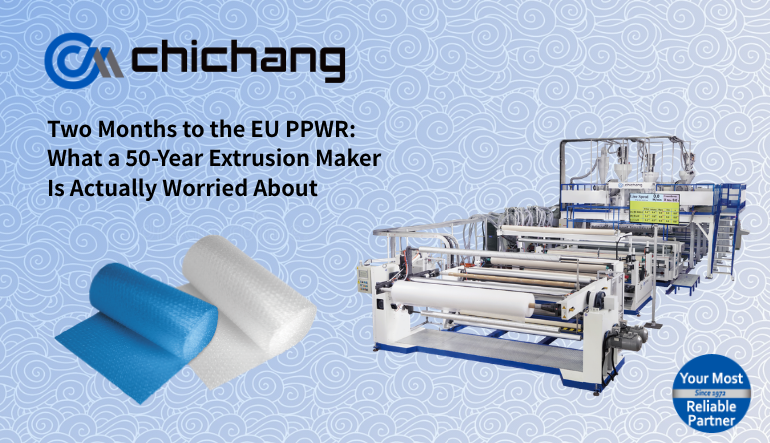
Chi Chang is an extrusion-machinery manufacturer founded in Tainan in 1972 — now past fifty years — with a consistently clear focus: film extrusion, air-bubble film, foam board, multilayer co-extrusion, and sheet lines. As early as 1980, it was exporting complete lines to markets including the UK, Russia, Australia, Japan, Canada, and the US. Along the way, it accumulated a series of Taiwan-first records — Taiwan's first PS foam-board line, its first HDPE mono-axially oriented bag-blowing machine, its first PP hollow corrugated-board line, its first PVC foam-board line, its first multilayer PE stretch-film extruder, its first BOPP biaxially oriented shrink-film line, and its first CPE breathable-film line. In 2007, it partnered with Belgium's ECONCORE to develop PP honeycomb pallets, using a lightweight structure to replace heavy conventional corrugated board and plastic pallets.
Laid out together, these records share a common essence: each involved taking a material that was relatively difficult to handle at the time, or a structure that was relatively difficult to form, and finding a way to produce it stably on an extrusion line. From the early PS foam, to biaxially oriented BOPP, to breathable film, to honeycomb structure — none of it ran on off-the-shelf parameters. All of it was arrived at through repeated trials on the process itself.
The challenges of biodegradable resins and high recycled content are, at root, an extension of that same class of problem. What they test was never how elegant the material formulation is, but rather how deeply the process is understood across melting, residence, temperature, and venting — which happens to be precisely where a manufacturer with half a century in film extrusion has accumulated the most.
Back to the process: it comes down to three things
Lay out, one by one, the points where a PLA or PCR conversion tends to stall, and they nearly all revolve around the same three things:
● Gentle melting, sufficient residence time —
High-viscosity bioresins cannot be force-fed through the short screw used for PE; advance them too quickly, with too much shear, and frictional heat damages the heat-sensitive chains. The common industry approach is a higher L/D ratio, which provides a more generous, more gradual melting zone, allowing the material to plasticize evenly even at lower temperature settings, with enough time and distance to do so. This is not a special technology but a basic principle of heat-sensitive extrusion; achieving it stably, however, rests on years of accumulated experience.
● Stable temperature control —
That ±5°C window for PLA cannot be solved simply by setting the right temperature; it is held by independent zoned temperature control paired with real-time feedback, keeping the melt temperature within range throughout. Should the temperature drift even slightly, the product's mechanical properties and degradation characteristics drift with it; this ability to hold temperature steady is, for a manufacturer long engaged in breathable and precision film, a fundamental skill.
● Adequate venting —
The moisture and volatiles carried in recycled feedstock must be removed within the barrel; otherwise they enter the sheet and film, forming visible bubbles and measurable gauge variation. Whether the venting design is up to the task is often the dividing line between whether a high-recycled-content formulation can be produced stably at volume.
All three are straightforward to state, yet each rests on accumulated process experience — not something resolved automatically by installing a new machine with an impressive spec sheet.
The regulation is the deadline; process is the readiness
August 12 is a deadline that cannot be avoided or negotiated. But whether a line can be adjusted in time to keep producing compliant material after a switch does not ultimately come down to whose spec-sheet figure is more impressive — it comes down to how deeply the extrusion process itself is understood.
For manufacturers evaluating a material switch, or already being asked by downstream customers to move to compostable or high-recycled-content formulations, the more useful step is not to rush toward asking which machine on the market has the best numbers. It is to step back and confront a more practical question: can the existing line's screw design, temperature zones, and venting capacity hold up under this new material? That is where the real decisions are made after August 12 — who ships, and who is held at the door.



Кооперативный партнер