


 English - EN
  繁體 - ZH-TW
  简体 - ZH-CN
  Español - ES
  日本語 - JA
  العربية - AR
  Русский - RU
  Français - FR
High Output Is Not Enough: What Really Determines Sellable Production in Blown Film?
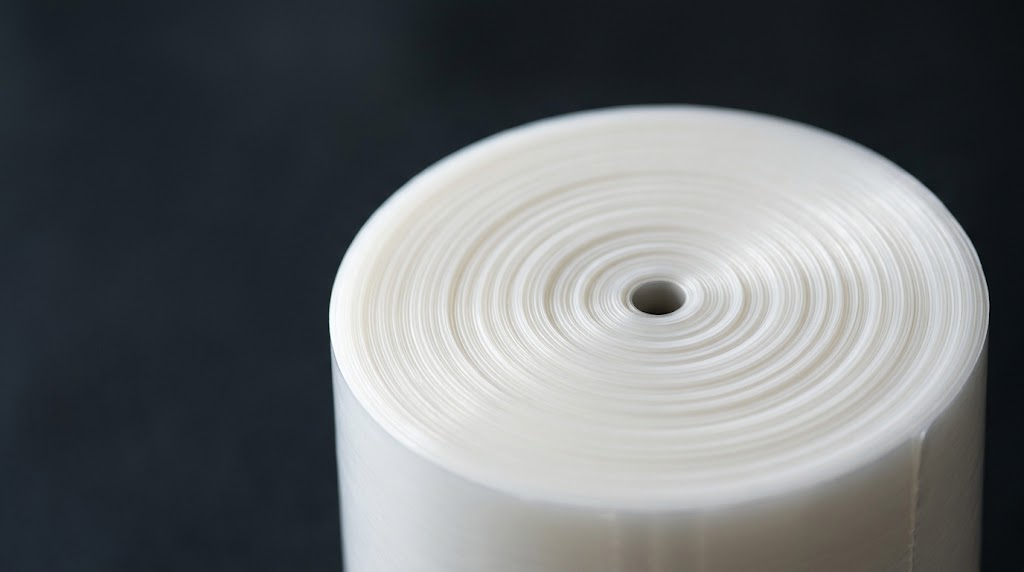
IMAGE POSITION | PLASTAR blown film line in stable production, with finished roll and thickness-profile detail.
| Production Pain Point | PLASTAR Solution | Customer Value |
| High peak output does not guarantee more qualified rolls. Start-up waste, downtime, thickness variation and winding defects reduce sellable production. | PLASTAR treats extrusion, cooling, thickness measurement, haul-off and winding as one coordinated production system. | More qualified film per shift, lower hidden resin loss, stable downstream converting and more predictable delivery. |
Why stable operation, thickness control and winding quality matter as much as kilograms per hour
A blown film line may reach an impressive output during a short trial, but kilograms per hour alone do not determine profitability. Film produced during start-up, thickness adjustment or unstable operation may become scrap instead of a sellable roll. Winding defects and downstream printing or lamination problems can reduce the usable output even further. For film producers, the more useful question is not simply, "How fast can the line run?" but "How much qualified film can it deliver during a complete shift?"
Manufacturing efficiency is commonly evaluated through three connected factors: availability, performance and quality. Availability measures how much planned production time is actually used for running. Performance reflects whether the line can maintain its intended operating rate. Quality measures how much total output passes requirements without rejection or rework.
| Sellable production = Rated output x Planned production time x Availability x Performance x Quality |
Consider an illustrative blown film line rated at 500 kg/h over an eight-hour production period. Its theoretical output is 4,000 kg. If availability is 90%, performance is 95% and first-pass quality yield is 97%, the calculated sellable production is approximately 3,317 kg. The remaining theoretical capacity is lost through downtime, reduced operating speed and non-qualified output. This is an illustrative calculation rather than PLASTAR customer performance data, but it shows why rated output and delivered output can be very different.
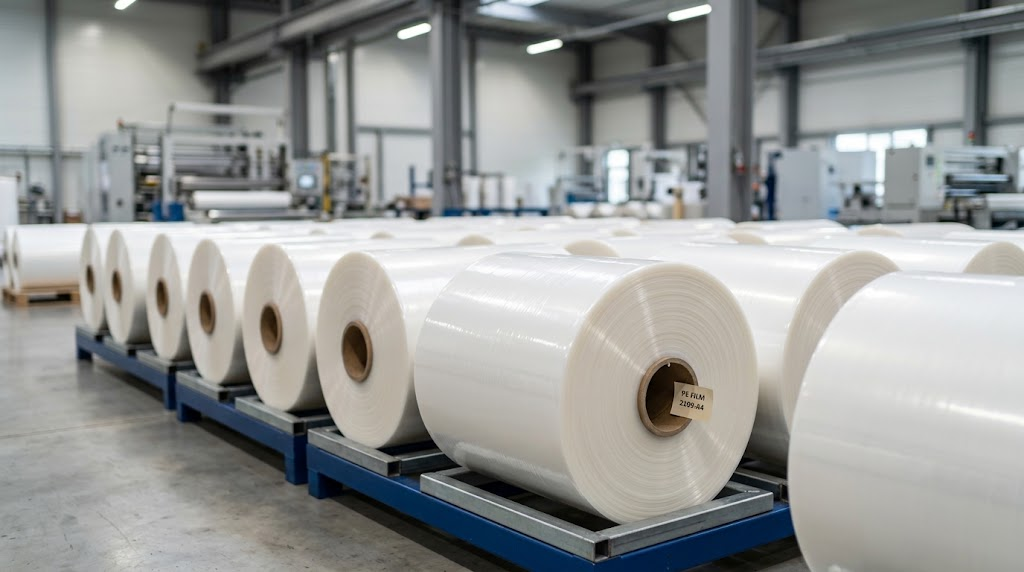
Start-up and product changeovers are often the first areas of loss. Each change in resin formulation, film width, thickness, blow-up ratio or layer structure may require the operator to re-establish stable extrusion, bubble geometry, cooling and winding conditions. A line that reaches a high speed but takes too long to stabilize can produce substantial transition waste, especially for converters handling frequent small orders. Recipe management, coordinated drives and repeatable process settings therefore influence daily profitability, not just operating convenience.
Thickness variation creates another form of loss that is less visible than rejected film. When the thinnest area must still meet the customer's minimum specification, producers may increase the average thickness to create a safety margin. Under the same film width, length and material density, every 1% unnecessary increase in average film thickness represents approximately 1% more resin used for the same saleable area. The film may pass inspection, but extra material has been consumed without creating additional sellable surface.
For this reason, thickness measurement is most valuable when it is connected to process correction. A rotating thickness gauge can identify the cross-direction profile, while an automatic air ring adjusts sectional cooling around the bubble. PLASTAR's available configuration combines gauge feedback with an automatic air ring using 120 independent control units. The objective is not merely to display thickness data, but to shorten correction time, improve profile consistency and reduce dependence on repeated manual adjustment. Actual performance depends on film structure, resin formulation, output rate and operating conditions.
Bubble stability and continuous running speed are equally important. A line may achieve its headline output for several minutes under ideal conditions, yet need to slow down when ambient temperature changes, cooling becomes insufficient or the bubble begins to move. Stable extrusion, die design, cooling capacity, internal bubble cooling where required, haul-off control and operator settings must work together. The most useful production speed is therefore the rate that can be maintained while thickness, width and film properties remain within specification.
Production does not become sellable simply because the film has passed through the nip rolls. Poor tension control, wrinkles, telescoping, uneven roll hardness or edge misalignment can downgrade an otherwise acceptable film. Problems may only become visible during printing, lamination, slitting or bag making, where unstable rolls cause registration errors, web breaks or additional setup time. Winding should therefore be evaluated as part of product quality rather than as the final mechanical action of the line.
The difference becomes clear when comparing improvement strategies. In the earlier illustrative example, increasing rated output by 5%, from 500 to 525 kg/h, while keeping availability, performance and quality unchanged would raise calculated sellable production from about 3,317 kg to 3,483 kg per eight-hour period. By comparison, keeping the original 500 kg/h rating but improving availability to 93%, performance to 97% and quality to 98% would produce approximately 3,536 kg. The calculation does not predict a guaranteed result, but it demonstrates an important investment principle: removing several small production losses can create more value than increasing maximum speed alone.
This is why PLASTAR approaches a blown film line as an integrated production system. Extrusion stability, cooling, automatic thickness control, haul-off, tension management and winding must be matched to the film application and production pattern. A producer of long, standardized commodity runs may prioritize output and energy efficiency, while a converter with frequent order changes may obtain more value from fast stabilization, recipe repeatability and reduced transition waste. Equipment configuration should follow the customer's actual product mix rather than a single headline specification.
Before purchasing or accepting a blown film line, producers should evaluate it over a representative production period. Useful records include the time required to reach stable production, scrap generated during start-up and changeovers, sustainable running output, thickness distribution, average film weight, downtime, qualified roll ratio and performance in downstream converting. A complete shift or complete order provides more decision value than a short maximum-output demonstration.
High output remains important, but only when it becomes stable, qualified and deliverable production. By focusing on the amount of good film produced per shift, manufacturers can make better equipment decisions, identify hidden resin losses and calculate return on investment more realistically. The strongest blown film line is not simply the one that runs fastest. It is the one that repeatedly converts resin, time and energy into rolls the customer is willing to accept and pay for.



Кооперативный партнер